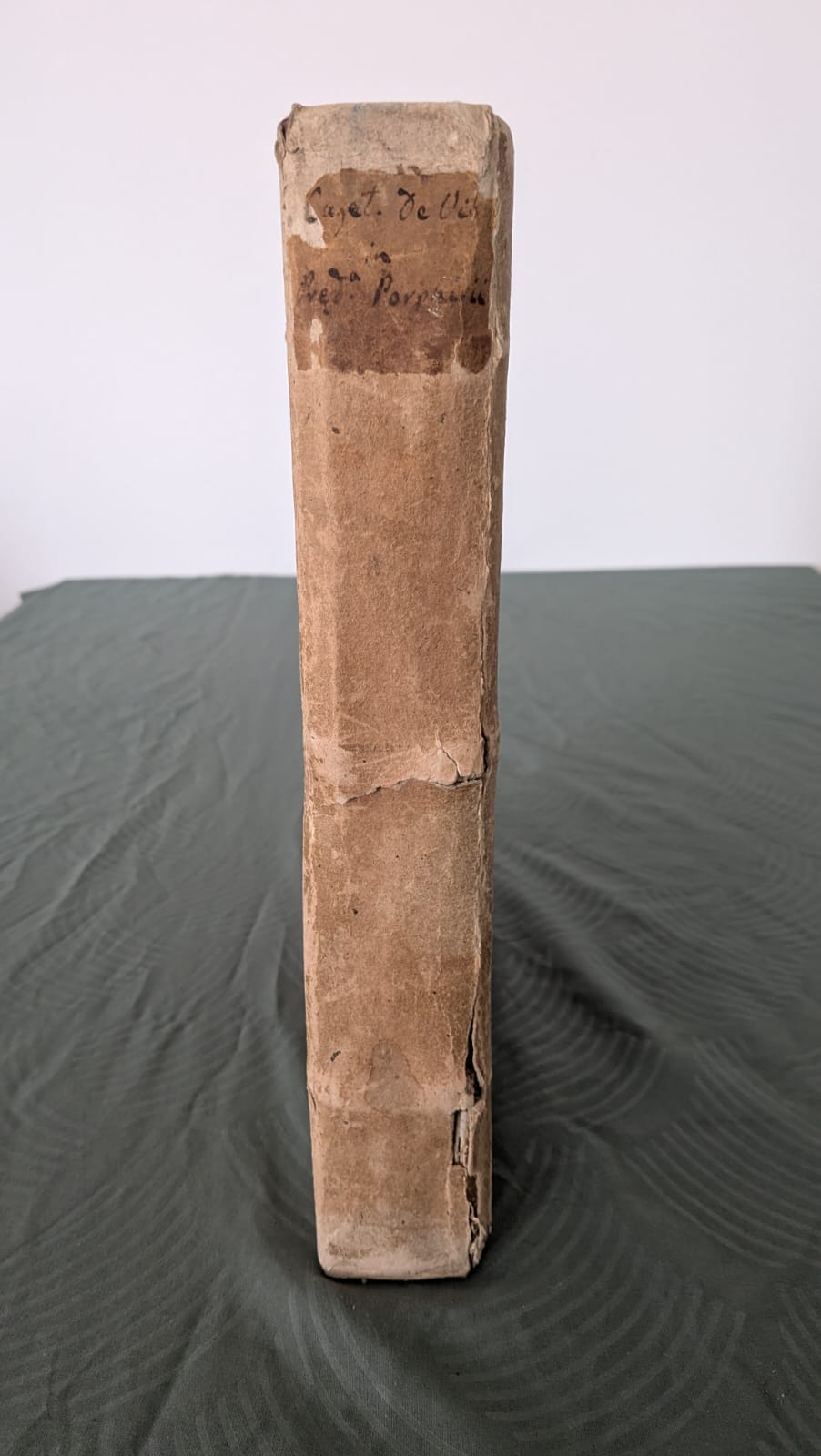
Thomae De Vio Caietani Praedicabilia Porphyrii - 1556 & S. Thomae Aquinatis praeclarissima commentaria in 2 volumes (very rare) - 1568
Thomae De Vio Caietani Praedicabilia Porphyrii - 1556 & S. Thomae Aquinatis praeclarissima commentaria in 2 volumes (very rare) - 1568
Couldn't load pickup availability
In Praedicabilia Porphyrii, Praedicamenta & libros Posteriorum Analyticorum Aristotelis …“ Venice, apud Iuntas, - 1556
Author: Thomas de Vio Cajetan
Language: Latin
Publisher: Venice, Giunta, 1556
This work is by Thomas de Vio Cajetan (1469–1534), a prominent theologian, philosopher, and cardinal. It is a comprehensive commentary on classical logic, particularly on Porphyry and Aristotle. In it, Cajetan addresses fundamental questions such as: How do we organize things into concepts and categories? What distinguishes genus, species, and individual things? How are definitions formed? How does a logically valid conclusion work? When can an assertion be considered proven? And how does one actually arrive at certain knowledge?
An important starting point is Porphyry's so-called five predicables: genus, species, difference, property, and accident. This is followed by Aristotle's categories and finally the Analytica Posteriora, or Aristotle's theory of scientific demonstration. Philosophical Renaissance print from 1556 with Cardinal Thomas de Vio Cajetan’s commentaries on the logic of Porphyry and Aristotle. Covers, among other things, conceptualization, categories, logical inferences, argumentation, and the foundations of scientific knowledge.
Praeclarissima Commentaria in libros Aristotelis Perihermenias & Posteriorum Analyticorum“ Venice, apud Iuntas, - 1568
Author: Thomas Aquinas
Language: Latin
Publisher: Venice, Giunta, 1568
Significant Venetian Renaissance print from 1568 with Thomas Aquinas's commentaries on the logical writings of Aristotle. Covers language and meaning, truth and falsehood, logical propositions, possibility and necessity, as well as the foundations of proof, cognition, and scientific knowledge. A famous philosophical problem involves statements about the future: If I say today that a certain event will take place tomorrow – is this statement already true or false today? This leads to questions regarding necessity, possibility, and human freedom.
The second major area is, in turn, Aristotle's “Analytica Posteriora”. In it, Thomas Aquinas examines what constitutes a genuine scientific proof and what distinguishes knowledge from mere opinion. It deals with causes, the prerequisites of a proof, definitions, and how new knowledge can be derived from known principles. The edition also contains the old and a humanistic Latin translation as well as additions by Cajetan and a compilation on logic from other writings of Thomas Aquinas.
Shipping
Shipping
We ship with the shipping service provider DHL. Depending on the country, the price varies for delivery to (DE, AT, CH, or International). After shipping, you will receive your tracking number from the respective shipping service provider so that you always know where your order is.
Return
Return
Don't like the item??
Return it to us within 10 days. See right of withdrawal.